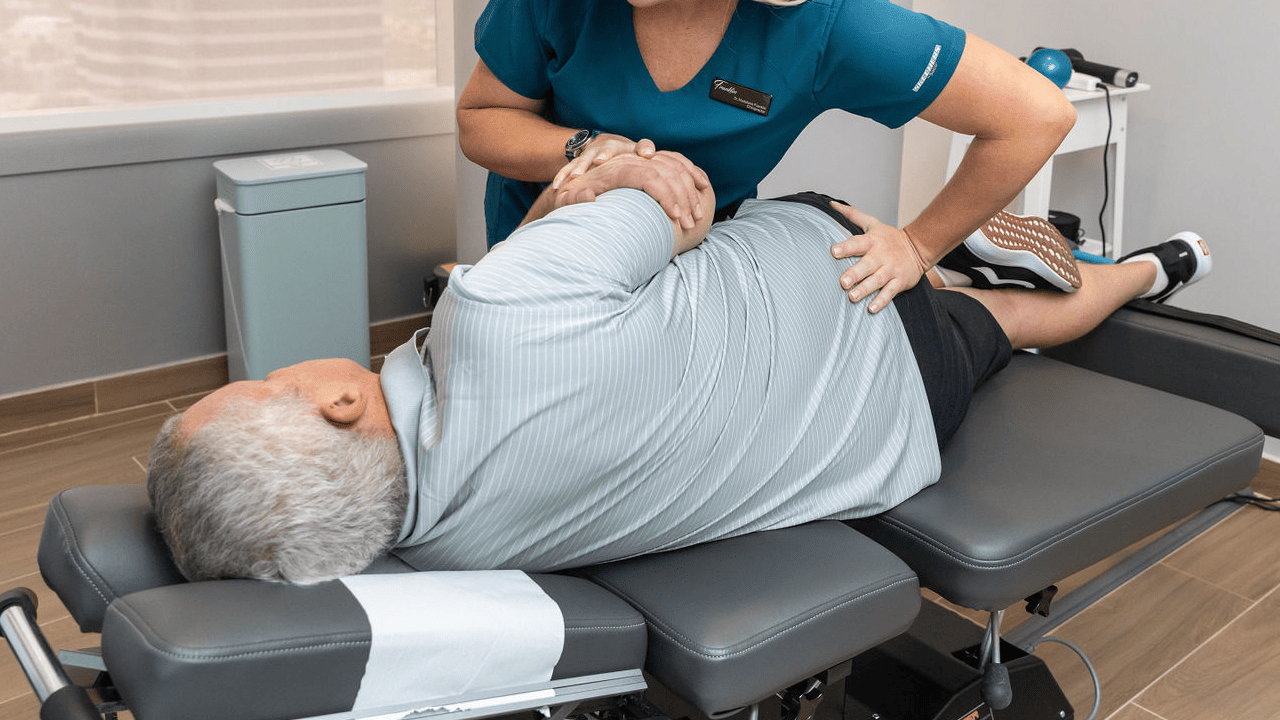
In-Person vs. Online
"The definition of insanity is doing the same thing over and over and expecting different results." — Albert Einstein
Why Online Rehab Is Not a Lesser Version of In-Person Care... It's a Better One
Let me ask you something.
When does your herniated disc actually flare up?
Is it during your Tuesday 2pm PT appointment?
Or is it at the gym when you try to exercise and feel that familiar shooting pain fire down your leg?
Is it during your Thursday session with your chiropractor?
Or is it on the golf course 400 miles from home when your back locks up on hole 7 and you don't know whether to push through or stop?
Is it when your PT is watching you?
Or is it at 9pm when you're lying in bed wondering why your leg is numb again and your next appointment isn't until next week?
Your disc doesn't flare up on a schedule.
But your care is restricted to a few hours a week.
And that gap, between when the problem actually happens and when you finally get to talk to someone about it, is exactly why you're still stuck.
The Dirty Secret About Traditional PT
Here's what a typical in-person PT schedule looks like.
Two appointments a week. Maybe three if you're lucky. Each one about 45 minutes to an hour.
That's roughly 2 hours of guided care per week.
Out of 168 hours.
You spend the other 166 completely on your own.
No guidance when you're at the gym and something doesn't feel right. No answers when you wake up at 3am with numbness shooting down your leg. No support when you're traveling for work and your back locks up in a hotel room.
Just a sheet of exercises and a reminder to ice it.
That's not a support system.
That's a scheduled check-in.
And for a condition as unpredictable and life-disrupting as a herniated disc, a scheduled check-in is not enough.
The Other Problem Nobody Talks About
Even during those 2 hours a week... are you actually getting what you need?
Most physical therapists are generalists. They see 30 different conditions throughout the week. Knee replacements. Rotator cuff tears. Post-surgical rehab. Chronic low back pain.
They're skilled at what they do.
But what they do isn't what you need.
You don't need a generalist who hands everyone the same sheet of exercises.
You need someone who specializes in exactly your problem. Someone who understands herniated discs, directional loading, nerve pain, and what it takes to get an active adult back to lifting, exercising, and living without fear.
Specialization matters.
And in a traditional clinic model, you rarely get it.
You get whoever is available on Tuesday and Thursday.
What Online Rehab Actually Is
I want to clear something up.
Online rehab is not a watered-down version of in-person care.
It is not a compromise you make when you can't find a good local PT. It is not a lesser option for people who don't have access to a clinic. It is not a Zoom call where someone watches you do bird dogs.
Online rehab, when it is done right, is a fundamentally better model for people with herniated discs.
Here's why.
Your Life Doesn't Happen in a Clinic
Think about where your pain actually shows up.
It shows up at the gym. On the golf course. At your kid's baseball game. In the car on a long drive. At your desk after three hours of back-to-back meetings. In bed at night when you can't find a comfortable position.
None of those places are a clinic.
So why is all of your care happening in one?
With online rehab I am with you everywhere.
You're on a golf trip and your back locks up on hole 7. I'm right there with you.
You're at the gym and something doesn't feel right during a deadlift. Send me a video.
You have a question at 9pm about why your leg is numb again. Message me.
That's not a lesser version of care. That's a better one.
The Environment Advantage
Here's something in-person PT can never replicate.
I can see your actual environment.
Your home gym. Your office setup. Your bed. Your car seat. The specific movements in your daily life that are loading your spine in the wrong direction.
And I can turn all of that into a personalized rehab center.
No generic exercises designed for a clinic floor. No movements that don't translate to your real life. No guessing about what's causing your flare-ups.
Just a plan built around your specific body, your specific environment, and your specific goals.
Wherever you are. Whenever you need it.
What You Actually Need
Let me be direct.
If you have a herniated disc and you're still stuck (still dealing with recurring flare-ups, still afraid to exercise, still waiting for the next appointment to ask a question that's been bothering you for a week) the model you're using is the problem.
Not your disc. Not your body. Not your effort.
The model.
You need three things that traditional in-person care almost never provides:
Specialization. Someone who focuses exclusively on your specific problem. Not a generalist who sees 30 different conditions a week.
Availability. Someone who is there when life actually happens. Not just Tuesday and Thursday.
Personalization. Someone who can see your environment and build a rehab plan around your real life. Not a generic template designed for a clinic floor.
That is what online rehab actually is.
And that is exactly what we do.
The Bottom Line
In-person care has its place.
But for active adults with herniated discs who are stuck in the gap between better and fully recovered, it is not enough.
You deserve care that meets you where you are. That's available when your disc actually flares up. That's built around your specific body and your specific life.
Not a scheduled check-in twice a week.
A real support system. Everywhere you go.
The information in this blog is for educational purposes only and does not constitute medical advice. It is not intended to diagnose, treat, or replace the care of a qualified healthcare professional. Always consult your provider for medical advice.