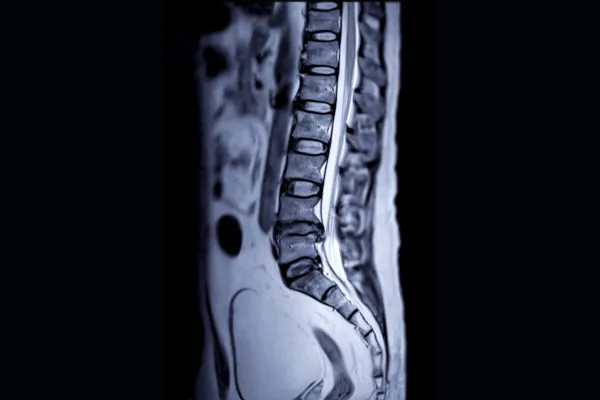
Your MRI Doesn't Paint The Picture
"Out of suffering have emerged the strongest souls; the most massive characters are seared with scars."— Kahlil Gibran
Your Herniated Disc Is Not A Death Sentence... It's a Wake Up Call
You got the MRI results back. The report says herniated disc. Maybe L4-L5. Maybe L5-S1. Or maybe multiple levels. And now you're terrified to move.
You're scared to bend over to pick something up. Scared to lift your kids. Scared that one wrong movement is going to make everything worse.
I get it. That piece of paper feels like a verdict. But here's what I need you to understand:
That fear (not your disc) is the thing keeping you stuck.
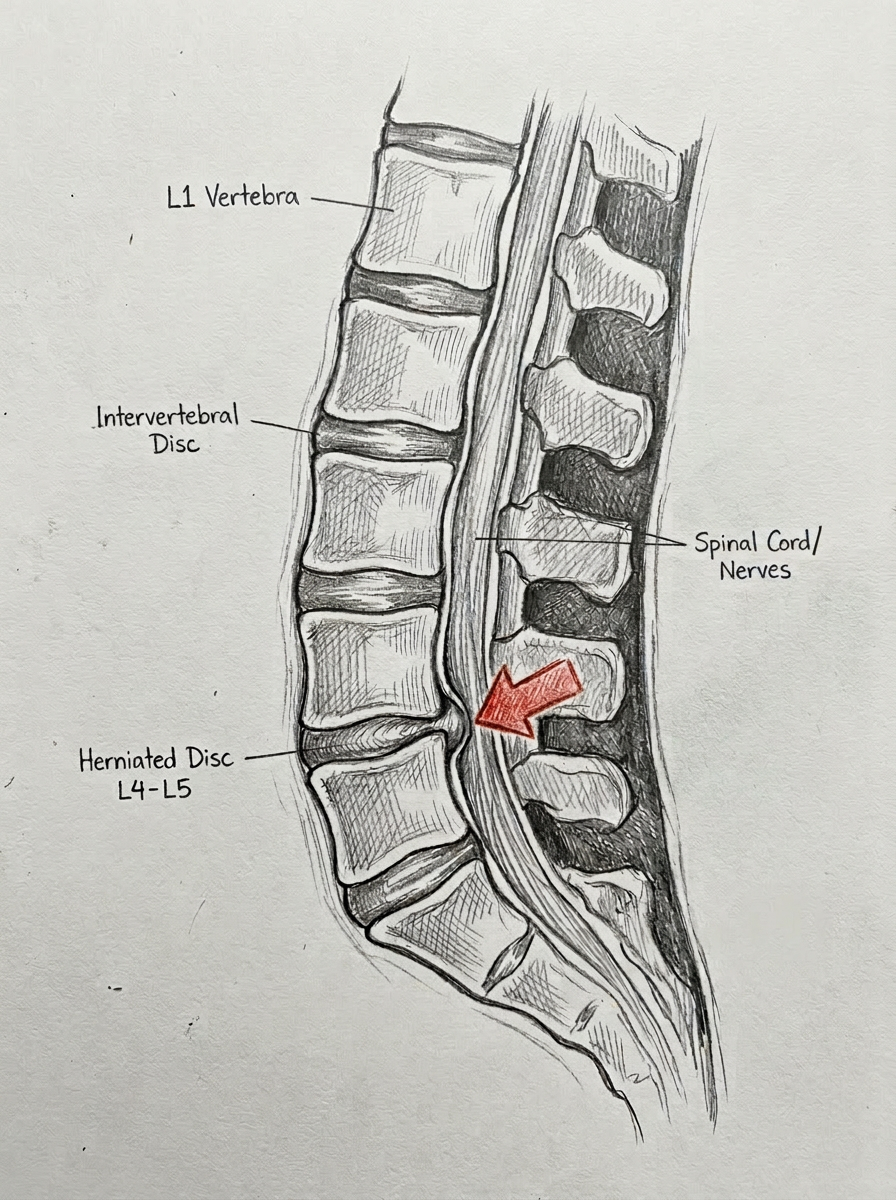
What Most People Do After a Herniated Disc Diagnosis
They treat their spine like it's made of glass. They stop exercising. They stop playing with their kids. They avoid bending, lifting, twisting. They spend hours Googling worst-case scenarios at 2am. And two years later?
They're weaker. More afraid. And still in pain.
Not because their disc got worse. But because fear convinced them that stillness was safety. However, it is not.
Here's What I've Seen After Working With Hundreds of Active Adults
There are two types of people who come to me with a herniated disc.
Person A sees the MRI, reads the report, and decides they're broken. They protect. They avoid. They wait for someone to fix them.
Person B sees the same MRI, reads the same report and decides they want to understand what actually happened and fix it.
Same diagnosis. A different mindset and a completely different outcome.
Person A stays stuck in a pain cycle that slowly shrinks their world.
Person B comes back stronger, more resilient, and more confident in their body than before they were ever injured.
I've seen it hundreds of times. The difference is never the disc.
It's always the mindset and the plan.
Why Your Disc Actually Herniated
If you feel the same way as Person A, don't blame yourself... A 10-minute appointment is not enough to teach you all of this.
Your disc didn't herniate because you're fragile.
It herniated because your spine has been overloaded in one direction for months, maybe years, without any counterbalance. Sitting at a desk all day. Bending forward to tie your shoes, pick up your kids, lifting in the gym, etc..
The loading accumulated slowly. Quietly. Until one day your spine couldn't tolerate one more forward bend and became sensitive to movement.
Think of it like a cut on your knuckle. If you constantly bend your finger, you will continue to strain the cut and open it up a little more each day. Overtime it will become more irritated until you finally listen to it.
That's your spine.
And here's what that means for you:
If a directional overload pattern created the problem, a directional overload pattern can fix it.
The MRI Is Not the Full Picture
I want you to look at that MRI report differently. It tells you there's a herniation. It does not tell you whether you'll get better or not. It also doesn't necessarily tell you what's causing your pain. And it absolutely does not tell you that you're broken.
Some of the most debilitating pain I've seen has come from people with "mild" herniations on their MRI. Some of the most complete recoveries I've seen have come from people with "severe" herniations.
The image is not the story.
How your body responds to movement, and your outlook on this situation tells the story.
When we find the direction that relieves your symptoms, we have a roadmap. And when you have a roadmap, everything changes.
What Recovery Actually Looks Like
It's not rest and it's not avoiding everything that hurts. It's understanding the pattern that created your herniation and systematically reversing it.
Building strength and resilience around your spine so it can handle the demands of your real life: picking up your kids, sitting through a work meeting, playing pickleball on a Saturday morning.
It's going from someone who is afraid of their own body to someone who trusts it completely. That's not a fantasy. That's what happens when you stop managing symptoms and start fixing the actual problem.
The Choice In Front Of You
You can let that MRI report scare you for the rest of your life. You can keep avoiding, keep protecting, keep shrinking your world down to whatever feels "safe."
Or you can use this diagnosis as a wake-up call. You can rebuild your body that's stronger and more resilient than it was before. You can get back to the things that matter the most: your kids, your career, your active lifestyle all without fear.
The herniated disc on your MRI is not a life sentence.
It's information. And information is power.
The information in this blog is for educational purposes only and does not constitute medical advice. It is not intended to diagnose, treat, or replace the care of a qualified healthcare professional. Always consult your provider for medical advice.